
ARTICLE
Your agents keep making the same mistakes. Nobody has time to fix it.
Discover how Tessl Agent automates error detection and task optimization, freeing your team from repetitive mistakes. Try it in open beta now!

Dru Knox
Your agents keep making the same mistakes. Nobody has time to fix it.
AI coding agents are getting better at the tasks you give them direct feedback on. Everything else stays broken.
You leave the same comment in code review three sprints in a row. There's a recurring task that could run as an automation but it's on the backlog because no one has time to stop and systematize it. The context your agents need to do better work — updated conventions, patterns from past PRs, recurring fixes — exists in your commit history and session logs. Nobody has time to extract it and package it up.
Agent enablement is real work. It just never gets done.
What teams usually do
Most teams handle this one of three ways: rely on PR review to catch the same errors week after week, schedule occasional cleanup sprints to update skills and conventions (that never actually get scheduled), or accept that their agents plateau.
All three require engineers to stop building to maintain the thing that's supposed to help them build faster.
Introducing Tessl Agent — open beta
Today we're launching Tessl Agent.
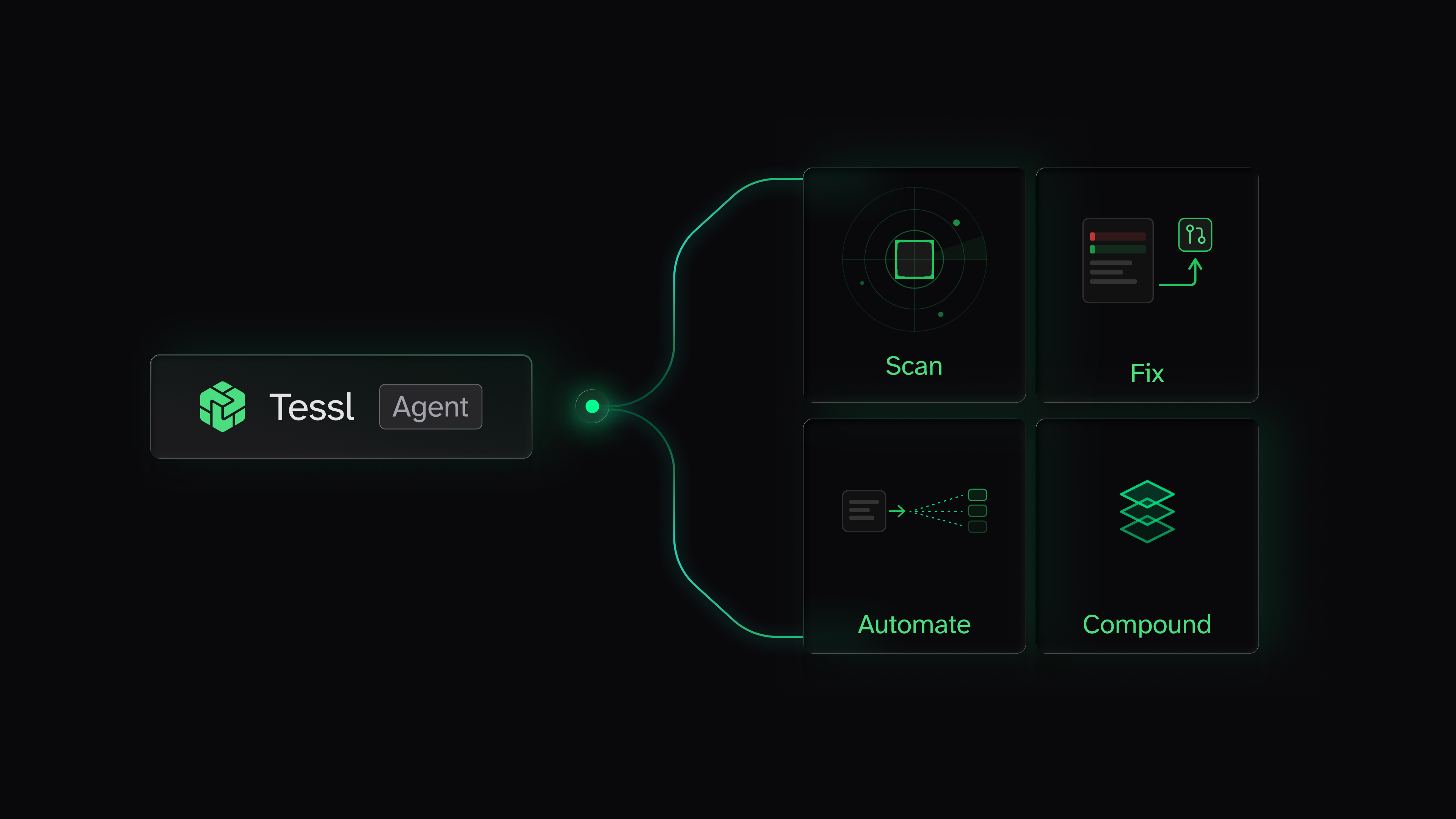
Point it at a repo. It scans your PRs, coding agent session logs, and tickets continuously. When it spots a recurring error pattern, it creates a skill to address it and opens a PR. When it finds a task your team runs manually every week, it turns it into a GitHub Actions workflow. Then it asks if you want it to keep doing that automatically; daily, weekly, on a schedule you set.
Tessl Agent is built to get you to stop using it interactively. You work with it, and at the end of each session it says: I could set some of these up as recurring actions. I could create a CI/CD check for this. The goal is that most of the recurring work — finding optimizations, catching agent mistakes, updating context — runs on a trigger and files issues without you having to ask.
What it looks like in practice
The use case we use most at Tessl: setting up an agentic code review harness.
You type something like set up agentic code review or I want to spend less time reviewing code. Tessl Agent scans your PRs, your issue tracker, and your coding agent session logs. It surfaces what's there: your style guide, common agent failure patterns, comments your team leaves repeatedly in review. Then it walks you through building on that.
First, it creates a code review skill that maps to your team's best practices. Unlike a one-click tool you forget about, this is a skill you own; you can update it, augment it, share it across workflows. From that point, every PR gets agentic review automatically. Then it sets up a recurring loop that optimises that review over time, so the quality of automated review improves as your codebase evolves.
You spend time reviewing code and shipping features, knowing the routine work is handled.
It works alongside your coding agent, not instead of it
Tessl Agent is not a replacement for Claude Code, Codex, or whatever you're using. It runs in the background. You don't context-switch to it mid-session.
It's also provider-agnostic — it works with CodeRabbit, GitHub Actions, and your existing stack. It's not tied to any one coding agent, which matters when you want something that works across your whole development workflow, not just within one tool.
The compounding effect
This is what loop engineering looks like in practice. Each automated improvement creates the conditions for the next one.
A skill that encodes a common pattern means your agent makes that class of error less often. An automated workflow that runs weekly means recurring tasks get systematised instead of repeated. At some point you look up and 40, 50% of your PRs don't have a human looking at them. You never had to run a big initiative to make that happen. You got started, kept building, and over time delegated more to the agent.
That's the path toward a software factory. Not a big-bang platform migration, but incremental agent enablement that compounds week over week.
Try it
Tessl Agent is in open beta and free to try. Download the Tessl CLI, run tessl, and open a session. A good starting point: pull up the last month of your team's coding agent sessions and ask what's broken, what's taking a lot of your time. The findings tend to be immediately useful.
Try Tessl Agent for free or book a demo.
COPY & SHARE
Dru Knox
AI product leader leading Product, Design, and AI at Tessl, with previous leadership roles at Google, Grammarly, Airtable, and AI startups.
READING
·
0%
IN THIS POST
COPY & SHARE
Dru Knox
AI product leader leading Product, Design, and AI at Tessl, with previous leadership roles at Google, Grammarly, Airtable, and AI startups.
YOUR NEXT READ
A Proposed Evaluation Framework for Coding Agents: Tiles Enhance Proper Use of Public APIs by ~35%
This article proposes an evaluation framework highlighting how specifications enhance coding agents' effective use of public APIs, increasing code quality and efficiency by approximately 35% amidst evolving software interfaces.



Maksim Shaposhnikov, Maria Gorinova, Rob Willoughby, Dru Knox