
Code review that makes your agents better with every PR
Tessl Code Review finds bugs in your PRs, then updates your code and standards so agents stop repeating them.
Start free with 1,000 credits a month
3 in 10
Agent PRs never get merged
Most fail on mistakes agents have made before. Stop repeats at the source.
The flywheel
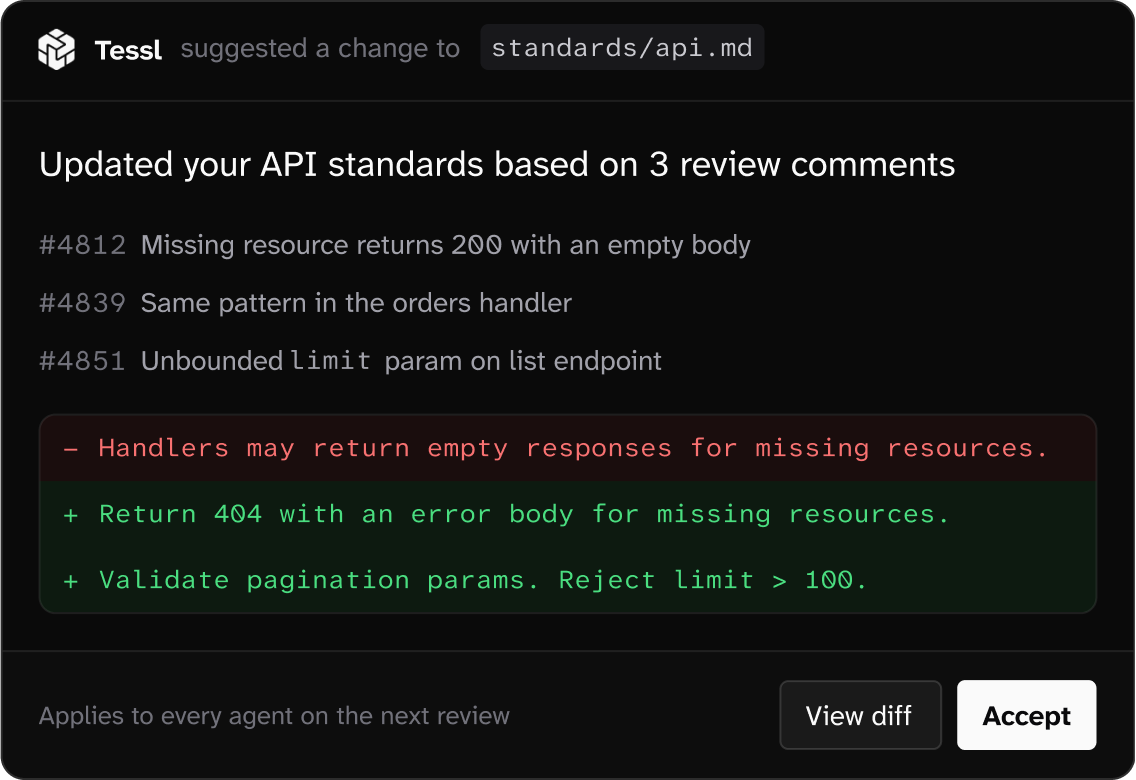
Fix it once. Every agent gets it right
Review findings show where your standards fall short. Tessl proposes the fix, you accept it, and the next review catches it. Reviews get faster and cheaper over time.
How we use it
How Tessl cut the cost of a merged PR by 4x
4x
lower cost per merged PR
90%
of PRs merged without human review
YOUR STANDARDS
Review every PR against your own standards
Your team already writes coding standards, design systems and architecture decisions for its agents. Most review tools ignore them. Tessl checks every PR against them, so every merge meets the bar your team set.
Start with code review. Grow your factory
Code review is where your factory learns what good looks like. Every other loop builds on it.
Turn tickets into reviewed PRs.
Writing code
Ticket
Linear, Jira
Coding agent
or a developer
Pull request
Pull request
the diff
Tessl Code Review
Live
Tessl reviewer app
Merged
approved
In your repo
Review lenses
Correctness · Security · Scale · Maintainability + yours
Example Tessl Code Review
Tessl Code Review
Changes required
Required
Security and Privacy
Returns email addresses to any signed-in user.
src/api/users.ts:48
Advisory
Maintainability and Code Quality
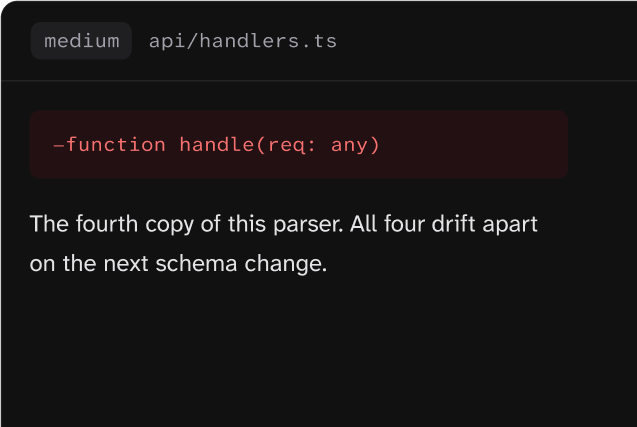
Rebuilds the existing retry() helper.
Advisory
Scale and Resilience
No timeout on the payments API call.
Out of the box
Cover four kinds of risk from day one.
Tessl Code Review ships with four lenses, each focused on one kind of risk. Use them as they are, customize them, or write your own.
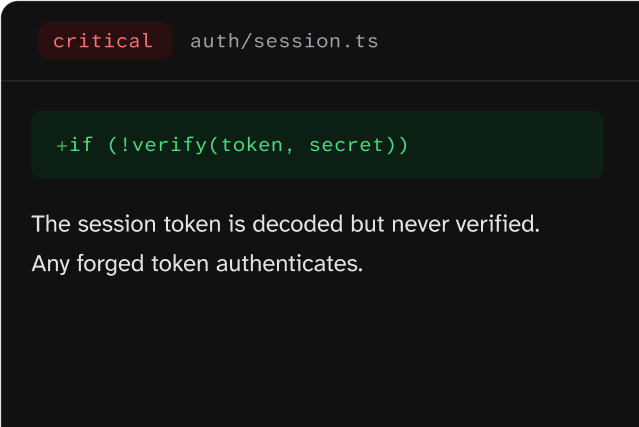
Security and privacy. Find vulnerabilities, exposed secrets and mishandled personal data.
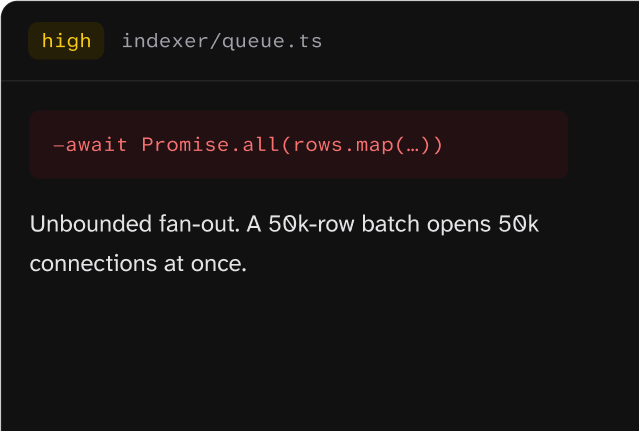
Scale and resilience. Find bottlenecks, missing error handling and single points of failure.
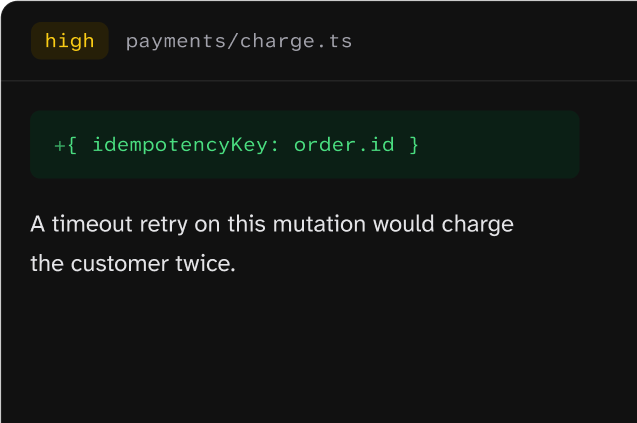
Correctness and data integrity. Catch logic bugs, and missed edge cases.
Maintainability and code quality. Flag complexity, duplicated logic and weak type contracts.
Frontier performance
Get the essentials of an AI reviewer
History, intent and re-review, included in every pass.
PR history and memory.
Uses past decisions so settled debates stay settled.
Semantic analysis.
Reads for what the code is meant to do, as well as what it says.
Re-review.
Picks up where the last round left off and flags fixes that regress.
Built for daily use
Get reviews your team will read
The same bar on every repo and every agent, with findings worth acting on and cost that scales with risk.
Cut the noise
91% of findings are real defects, so your team acts on comments instead of skimming them.
Match review depth to risk
A one-line typo fix doesn't need the scrutiny of a payments migration. Depth and cost scale with risk.
Review in the IDE, CLI and PR
Catch issues earlier, when they're cheaper to fix.
Go deeper on code review
A conversation with the team who built it, the launch writeup, and a free course if you want to build your own loops.

Video
Why we built Code Review
The engineers behind the tool explain what it does and why it works differently, in less than 5 minutes.

Free course · Tessl Academy
How to Build code review loops
Learn how to create your own review standard as a skill and put it to work with Tessl.
On-demand webinar
AI code review that keeps up with your agents
Your agents ship code faster than you can review it. Tessl Code Review puts a team of agents on every PR. Marc and Colin demo it live on a real one.
29 min
with Marc Sloan & Colin Hallett

Questions, answered.
How it works, what it costs and how it fits your workflow. Still stuck? Get in touch.
Tessl is an open platform for building your software factory, one loop at a time. It helps teams create, review and govern the standards their coding agents follow.
Tessl Code Review reads the whole pull request, not just the diff, and checks it against standards your team owns and writes in plain language. It runs a set of specialist "lenses," each focused on one concern (correctness, security, scale, maintainability), and publishes one verdict: approve or request changes.
Most AI reviewers look at the diff and apply generic rules. Tessl reviews against the standards your team wrote for its agents, and helps you improve them with every review, so your agents make fewer of the same mistakes.
No. Code Review is built to reduce noise and catch what a generic reviewer misses, so the time your team does spend reviewing goes to the things that actually need a person: architecture calls, product tradeoffs and anything a standard alone can't judge. Tessl Code Review can be configured to auto-approve after resolution, but a human is still required to merge the PR.
Yes. Re-review picks up exactly where the last round left off. It knows what's already fixed, what's been explained and what's been declined, so it only checks what's still open, and it'll flag it again if a fixed issue quietly regresses.
Yes. The four default lenses (correctness and data integrity, security and privacy, scale and resilience, maintainability) ship out of the box, but you can fork any of them or write your own, and scope any lens to specific paths in your repo.
It can run either way: advisory mode surfaces findings without blocking, gate mode enforces a check that has to pass before merge. You choose the mode per repo.
Tessl integrates with any model, agent or tool via MCP. It works with GitHub through a dedicated GitHub App, or as a GitHub Action if you want it running in your own CI.
Each code review round costs 50 credits. Free plans start at 1,000 credits per month, and paid plans start at $100/month for 5,000 credits and unlock the full Tessl platform, including Code Review, Skill Optimization, Security Scanning and more loops.