
In this episode
Is AI actually intelligent — or just very fast at guessing based on bad data?
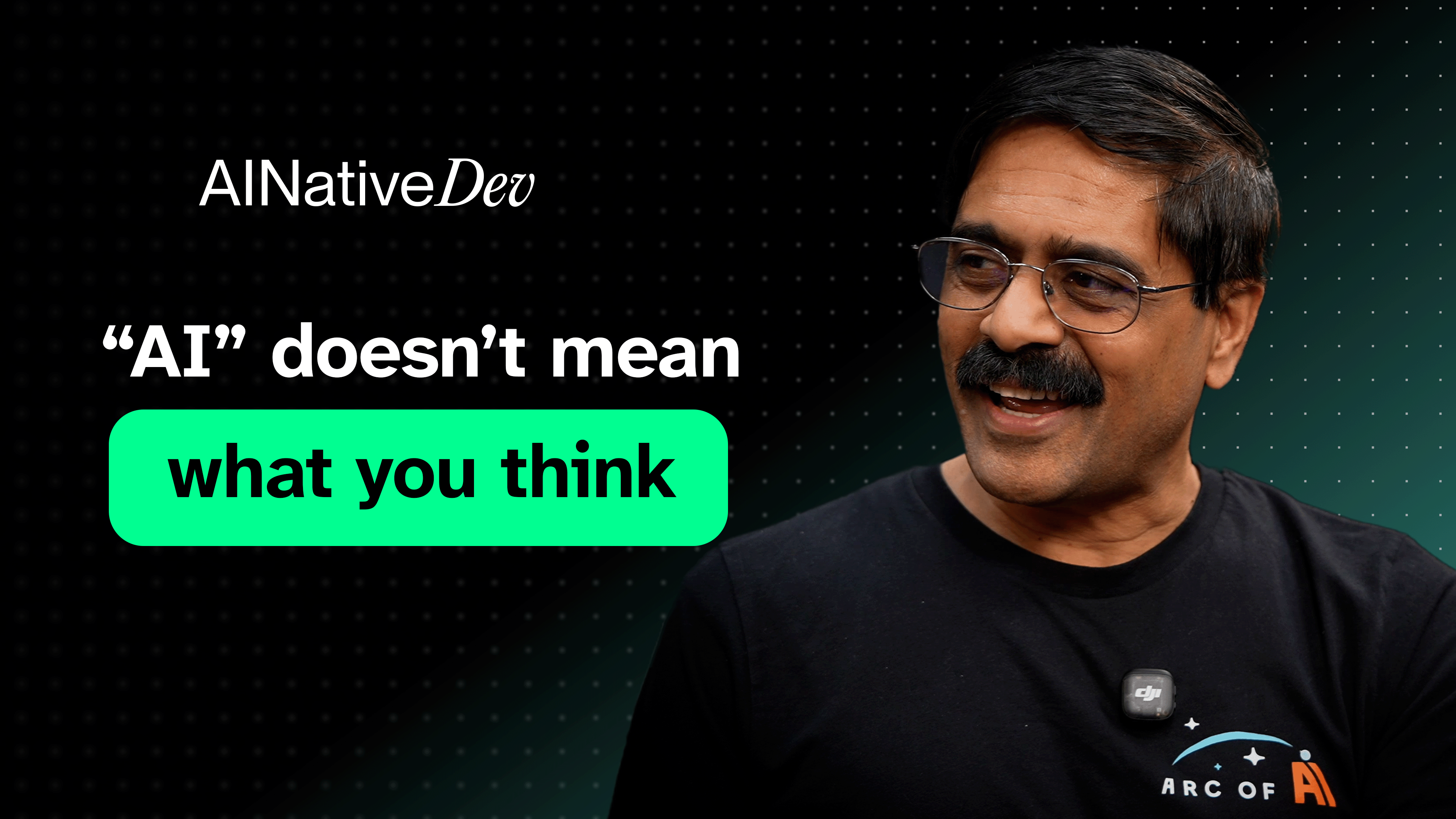
Venkat Subramaniam, 40-year programming veteran, educator, and co-founder of Arc of AI, joins the AI Native Dev Podcast to share a perspective that cuts through the hype: AI stands for Accelerated Inference — not Artificial Intelligence.
And that reframe changes everything about how developers should use it. In this episode, Venkat unpacks why the speed of AI generation has outpaced our ability to review it, why you can delegate work to AI but never your reputation, and tells the story of a $2 million feature that got cancelled with one simple question: "Why are we building this?"
🔑 Topics covered:
— Why "Accelerated Inference" is a more honest name for AI
— The code quality crisis AI has inherited from decades of bad human code
— Accountability, lawsuits, and professional responsibility in the AI era
— What makes a senior developer
— and why AI widens that gap
— The one question that should precede every feature decision
— Why vibe coding is the most overrated AI trend right now
AI Coding Agent Reliability Starts with Developer Discipline, Not Better Models
Few voices in the software development community carry the weight of four decades of practice the way Venkat Subramaniam's does. An author, educator, and conference co-creator, Venkat has spent 34 years watching technologies arrive, generate anxiety, and eventually settle into the fabric of how software gets built. In this episode of the AI Native Dev podcast, recorded live at the Arc of AI conference in Austin, the conversation kept circling back to a single uncomfortable truth: the challenge with AI coding tools is not that they aren't capable enough. It's that developers are not yet disciplined enough to use them well.
The Arc of AI: Where We Are on the Curve
Venkat co-created the Arc of AI conference with a specific purpose in mind. With all the noise surrounding AI, the goal was to bring practitioners together to make sense of what actually works rather than what vendors are trying to sell. The speakers are engineers who have shipped things, not representatives from AI companies with products to push.
The name itself carries meaning. Every significant technology in software history, from object-oriented programming to agile methodologies, has followed a predictable arc: a period of hype, anxiety, gradual adoption, and eventual normalization. Venkat sees AI following the same trajectory. The difference is that the hype cycle has been louder, and the speed of change has created pressure that makes it harder to slow down and think clearly.
"The problem in software is not that we don't have a technology," he noted. "We have a lot of it. The problem is we don't have enough discipline." That framing, discipline as the missing ingredient rather than capability, ran through the entire conversation.
One observation worth pausing on: between last year's conference and this one, Venkat has noticed the audience has changed. Developers have moved from passive listening mode into active engagement, bringing their current work into the room and asking how to apply what they're hearing. The community is crossing from "let me find out what AI is" to "let me figure out how to use it."
AI Coding Agent Accuracy Depends on Human Judgment
One of the more counterintuitive patterns Venkat described is what happens when junior and senior developers look at the same AI-generated code. Junior developers tend to see magic. Senior developers tend to see problems. The gap between them is not skill in using the tools. It's the depth of knowledge that allows someone to evaluate what the tools produce.
This creates a compounding risk. If developers become passive consumers of AI output, accepting what gets generated without the critical thinking to interrogate it, the speed advantage AI provides becomes a liability. Venkat put it plainly: "AI can replace our effort, but AI cannot replace our knowledge."
He used the example of working with chemical engineers to make the point concrete. A developer can write code that looks reasonable from a software perspective but is dangerously wrong from a domain perspective. The human with domain knowledge is the necessary check. Remove that check, replace human effort with AI effort that moves even faster, and the risk compounds rather than diminishes.
This is why coding agent reliability is not primarily a model problem. The model is often correct. The issue is whether anyone on the team has the knowledge to verify that correctness, and the discipline to do so consistently. As Venkat framed it, AI is "agonizingly inconsistent," and in a non-deterministic system, the developer becomes the source of control, not the tool.
How to Evaluate AI Agent Output: The Case for Iteration
One pattern Venkat pushes back on consistently is the impulse to one-shot complex problems with AI. The expectation that a single prompt should produce a deployable result conflates speed with quality in a way that typically produces neither. The more sustainable approach is iterative, where developers stay in the loop, evaluate at each step, and course-correct before compounding errors accumulate.
The discipline here is similar to what good CI/CD processes provide. Brakes on a car do not slow you down over the journey; they let you drive faster by giving you control. The same logic applies to the stage gates, code reviews, and feedback loops that development teams should be applying to AI-generated output. Skipping those steps in the name of speed tends to produce the kind of technical debt that takes months to untangle.
Venkat sees AI as genuinely valuable for specific tasks where this kind of disciplined evaluation is already happening: automated test generation for legacy codebases, root cause analysis across complex systems, refactoring and code explanation, and architecture review. These are areas where teams have already identified a problem, can specify what they need, and have the context to evaluate whether the output is adequate. The AI coding agent evaluation challenge is not finding where to use AI, it's developing the organizational practice of verifying what it produces.
This connects directly to how to evaluate AI agents in practice: the question is less about abstract metrics and more about whether the humans in the loop have sufficient knowledge and judgment to catch what goes wrong.
What It Means to Be a Good Developer in an AI-Native World
Perhaps the most thought-provoking part of the conversation was Venkat's honest account of his own moment of doubt. Riding a train in Europe a couple of months ago, staring out the window, he asked himself whether 34 years of teaching software craft had become irrelevant. Whether students could just learn what they needed from AI directly.
He concluded the opposite. He is more relevant now, not less. Not because he teaches SOLID principles or specific frameworks, though he does, but because what he is really teaching is how to think. Time management. When to go deeper and when to move on. How to push back. How to ask why.
That last skill runs through the conversation like a thread. In one story, Venkat described walking into a company that was preparing to reimplement a feature simply because the old system had it. When he kept pressing to understand why the feature was needed at all, the room grew uncomfortable. Eventually the company president revealed that 60% of their support calls came from that feature. Nobody had thought to question whether it should exist in the new system at all. It was removed entirely.
"AI may not be capable to pose that question," Venkat said. "But AI will answer those questions if you ask."
This is where the developer's role shifts with AI. For the past two decades, as search made answers freely available, the valuable skill became knowing how to ask the right question. With AI, that skill matters even more. The model has answers. The developer needs to bring the questions, including the hard ones about whether what's being built should be built at all.
A senior developer, in Venkat's framing, is not defined by years of experience or knowledge of frameworks. It's the ability to smell when something is wrong, to push back, to validate rather than accept. That sense, and the courage to act on it, is what keeps AI from amplifying bad decisions at speed. It is also, incidentally, what makes the shift toward spec-driven development (https://claude.ai/blog/spec-driven-development-ai) more valuable than ever: specs force the why conversation before a line of code gets generated.
The episode is well worth a listen for anyone thinking seriously about how engineering teams should build practices around AI rather than just tools. The full conversation is available at ainativedev.io.
CHAPTERS