
PODCAST EPISODE 111
Why Agents Are Forcing Enterprises to Finally Fix Their Dev Process
Most enterprises say they're adopting AI coding. What they're actually doing is installing tools and hoping for the best — and the agents are exposing every process shortcut they never fixed when humans were doing the work.
Transcript
In this episode
Enterprises are finally being forced to care about their software development lifecycle — not because anyone suddenly got disciplined, but because agents cost money and the waste is now visible. When it was humans, it was "Timmy's just lazy." Now it's a line item.
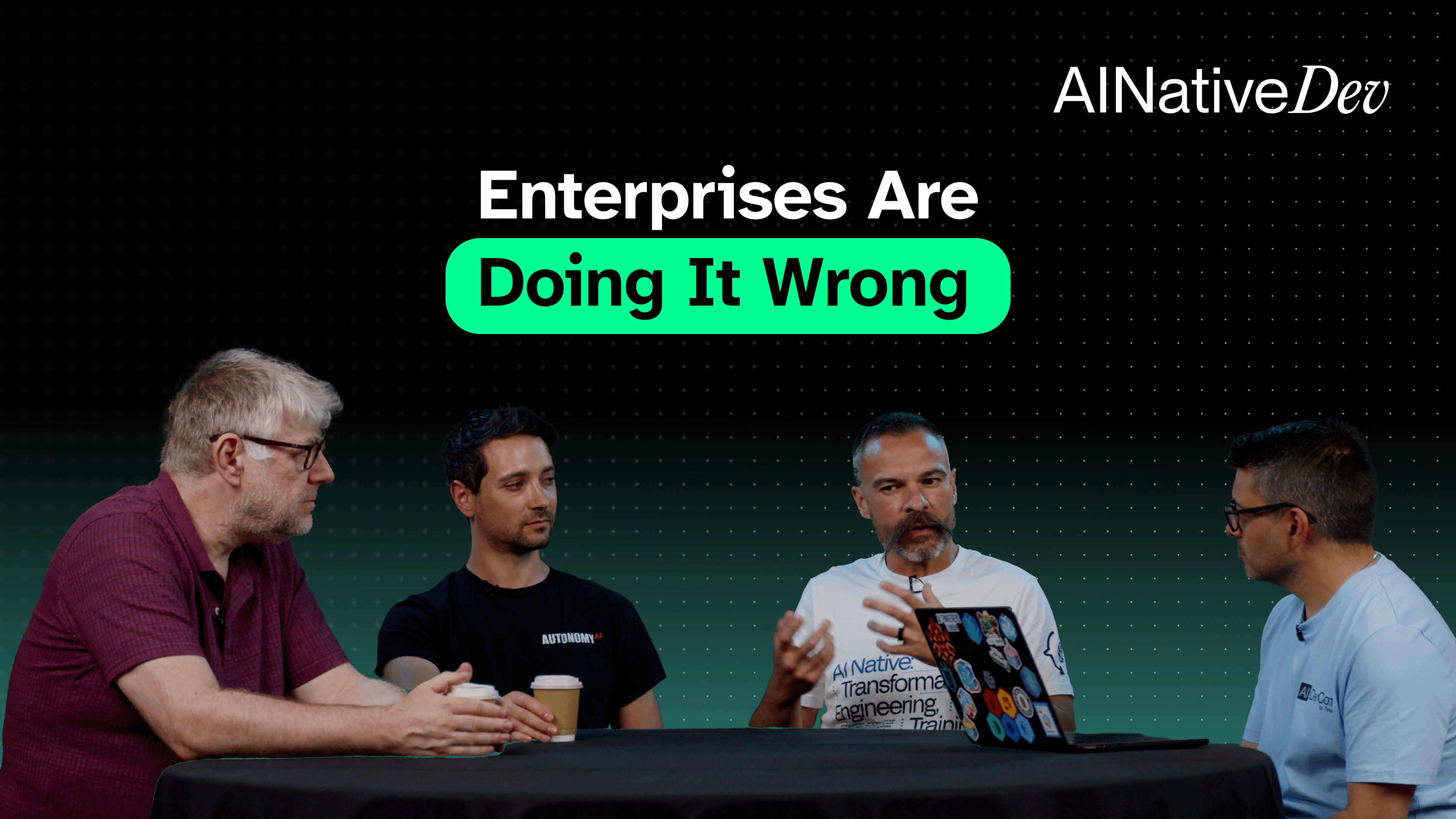
Simon Maple sat down with Patrick Debois (the godfather of DevOps, now DevRel at Tessl), Tammuz Dubnov (co-founder and CEO of Autonomy AI), and Daniel Jones (Head of Product at re:cinq) at AI Native DevCon London for a wide-ranging panel on AI enablement — who owns it, what's breaking, and what the organisations getting it right are actually doing differently.
What we cover:
- Who should own agentic coding adoption inside an enterprise, and why platform teams are already filling the vacuum
- The "Timmy's lazy" problem: why agent cost visibility is forcing process discipline that humans never got
- Why PR-based workflows are an anti-pattern inside enterprises once you're moving at agent speed
- The PUMP framework (Plan, merge, polish): how one team is shipping features with developers, PMs, and designers all opening PRs
- Rethinking what a "test" is in an agentic world — and why feedback loops matter more than first-pass correctness
- The biggest mistake enterprises are making right now: piecemeal adoption with no mandate and no shared tooling
🌐 Tessl: https://tessl.io
🔔 Subscribe for weekly episodes on AI-native development
What's your team's approach to AI enablement — central mandate or letting individuals find their own way? Drop it in the comments.
AI Enablement at Scale: What Enterprises Are Getting Wrong About Agentic Coding
The conversation about agentic coding inside enterprises tends to get stuck on tooling. Which IDE? Which model? Which vendor? A recent AI Native Dev podcast conversation suggests that's the wrong question — and that the organisations pulling furthest ahead have figured out something more fundamental.
At AI Native DevCon London, Simon Maple sat down with Patrick Debois (DevRel at Tessl and widely credited as the godfather of DevOps), Tammuz Dubnov (co-founder and CEO of Autonomy AI), and Daniel Jones (Head of Product at re:cinq) for an unscripted panel on AI enablement. What emerged was less a product discussion and more a diagnosis of why most enterprise adoption efforts are stalling — and what the exceptions are doing differently.
The "Timmy's Lazy" Problem: Agents Make Waste Visible
One of the sharpest observations in the conversation came from Daniel Jones. For years, organisations tolerated poor software delivery processes because the inefficiency was invisible. When engineers were the bottleneck, it was easy to attribute delays to individual motivation or skill. "It was like, oh well, Timmy's just lazy," Jones noted. "And they didn't focus enough on process and value stream mapping and all those important things."
Agentic coding changes the economics. Token costs are measurable. A disengaged developer who offloads all decision-making to an agent runs seven QA sessions where a focused developer would run one — and the difference shows up in the bill. Suddenly, value stream management is a finance conversation, not just an engineering one. If you're aiming for a 20% velocity increase from agentic adoption, Jones argued, you're already thinking too small.
Who Should Own Agentic Coding Adoption?
The panel agreed there's currently a vacuum. Most organisations don't have a clear owner for agentic coding — and the team that tends to fill it by default is the developer experience or platform team, partly because they already control model gateways and AI spend.
Patrick Debois framed it through the lens of how DevOps scaled: you need a small incubation team that establishes patterns others can replicate. "You need that one team that gets duplicated in multiple teams," he noted. The risk is that platform teams are still primarily infrastructure-minded rather than AI-workflow-minded — which creates a temporary skills mismatch.
The emerging pattern, visible in the data Debois has been pulling together via the Tessl Patterns site (an aggregation of real-world agentic coding practices from social media), is that the same things that made software engineering good before still make it good now: clear documentation, meaningful tests, observable systems. What's changed is the cost of ignoring them.
Rethinking Pull Requests at Agent Speed
One of the more provocative takes came from Debois, who argued that pull request-based workflows are "a damn silly idea" inside most enterprises. They make sense in open source — where contributors are not strategically aligned and trust has to be earned — but inside a team that shares context and goals, the overhead of a PR review cycle is increasingly hard to justify when agents are moving fast.
Tammuz Dubnov at Autonomy AI has pushed this furthest in practice. His team runs what he calls a "prepared PR" process: as soon as a PR opens, agents model different team members — trained on hundreds of historical comments — and review the code as those individuals. Agents then resolve the comments, run a retrospective check against error logs, and assess whether the change behaved as intended. For low-risk changes, Dubnov is working towards removing human review entirely.
The counterpoint, which Daniel Jones introduced, is the PUMP framework (Plan, Merge, Polish) that Autonomy AI uses internally. The core insight is that in a fast-moving codebase, long-lived PRs become unmanageable — by the time review is complete, the code has conflicted with everything. The solution is to merge quickly behind feature flags, then polish in a second pass once the feature is stable in the codebase.
What a Test Means When Software Factories Are Churning
The final section of the conversation touched on what may be the deepest question in agentic development: how do you assert quality when agents are generating code faster than humans can review it?
Daniel Jones reached for a Beyoncé lyric to frame it: "If you liked it, then you should have put a test on it." The principle holds — if you care about a behaviour, you need something in place to assert it. But in an agentic context, "a test" can mean something much broader than a unit test. It might mean an agent sweep with a specific quality lens (security, dead code, performance). It might mean connecting an agent to observability tooling via MCP so it can perceive when what it built and deployed is breaking in production. It might mean writing tests with enough context in assertions and error messages that a future agent reading them knows what to do — what Jones calls the "temporal mindset and context hinting mindset."
The common thread across all three guests was a critique of organisations that treat agentic coding as a purely additive change: install the tool, let people use it, see what happens. The research suggests that organisations with a firm mandate — Debois called it the "AI bus is leaving, please get on board" message from leadership — outperform those that leave adoption to individual discretion. But mandate without structure produces a different failure mode: poor-quality PRs overwhelming review queues, non-developers opening unreviewed code changes, and token spend running out of control.
The organisations further ahead have closed the loop between leadership intent and engineering process — and they're discovering that doing so requires exactly the kind of software engineering discipline that was always good practice. The agentic era hasn't changed the fundamentals. It's just made ignoring them more expensive.
This episode of the AI Native Dev was recorded live at AI Native DevCon London 2026. Listen on your podcast app or watch on YouTube.
CHAPTERS