
Transcript
In this episode
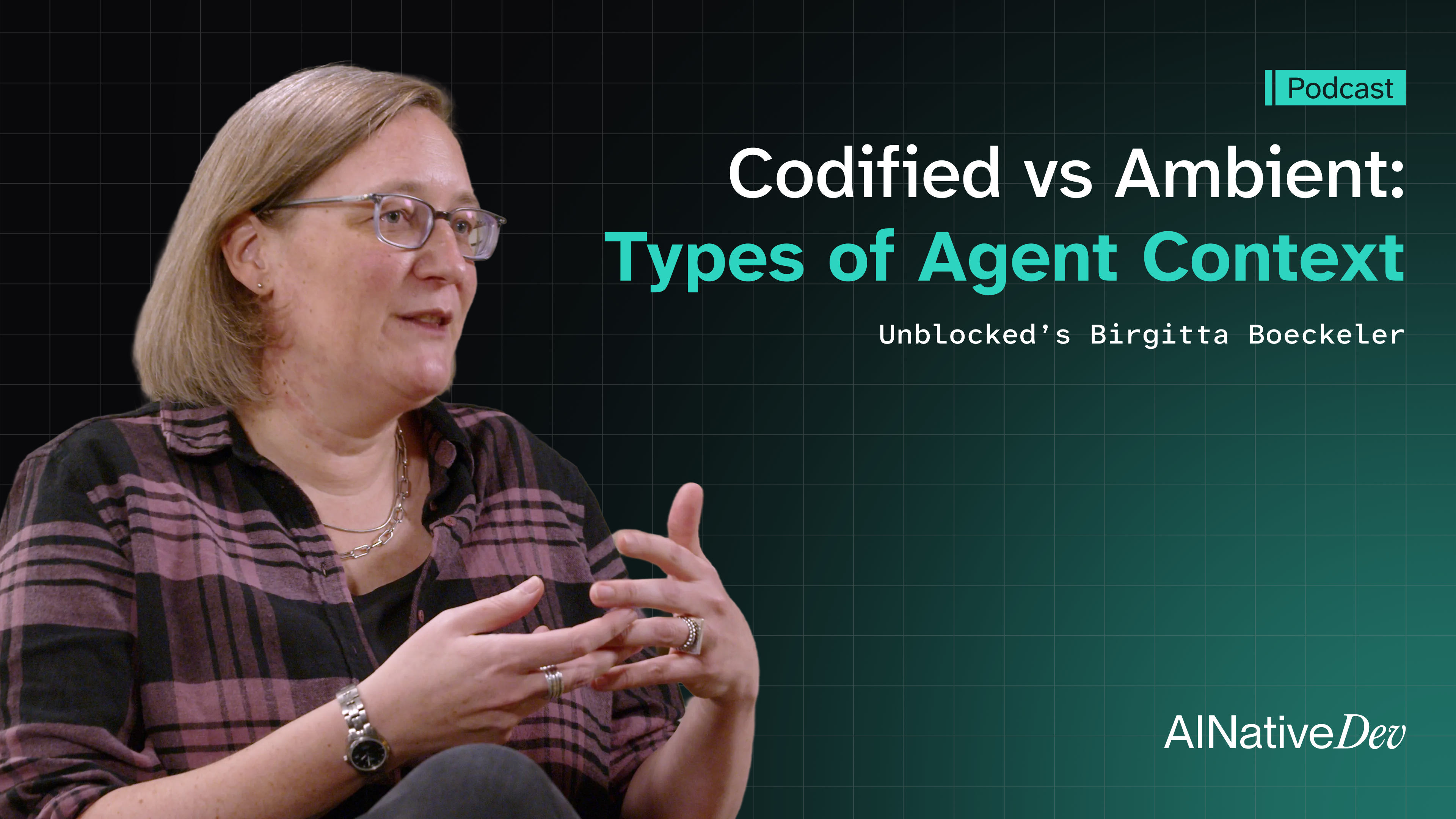
Context engineering starts with admitting that not all context is the same. Birgitta Boeckeler, now a principal engineer at Unblocked after almost 14 years at Thoughtworks, splits it into codified context you author and ambient context your agents pull from the environment, and explains why each needs its own delivery lifecycle.
Watch all the AI DevCon NYC 2026 talks:
https://tessl.co/p7w
Recorded live at AI DevCon NYC 2026, Simon Maple sits down with Birgitta to dig into why ten MCP servers can still leave an agent with too little context, how a context engine settles a conflict between a Slack thread and a README (often by checking the code), and when ambient knowledge should be promoted into a skill. Then stay for her full DevCon talk, Context != Context: One Window, Different Lifecycles, on what it takes to ingest, evaluate, assemble and observe ambient context.
What we cover:
- Codified vs ambient context, and why they need different delivery mechanisms
- Security and permissions when agents read and post organizational context
- Why MCP servers can leave an agent with too little context
- How context conflicts get resolved: recency, the code and an expert graph
- When ambient context should become a skill, and how to evaluate a context engine
- Birgitta's AI DevCon talk: a context engineering lifecycle for ambient context
Chapters:
00:00:00 - Introduction
00:03:56 - Security and permissions in a context layer
00:07:04 - Context != context: codified vs ambient context
00:10:58 - Organizational context and code as a source of reality
00:13:18 - Signal to noise: too much context, or too little
00:16:10 - Where organizational context helps most
00:19:04 - How a context engine resolves conflicting context
00:21:32 - When ambient context should become a skill
00:25:30 - Fixing repeated agent mistakes: guidance or sensors
00:32:54 - AI DevCon talk: Context != Context
Book early for AI DevCon London 2027, 7–8 June at The Brewery, Moorgate:
https://tessl.co/wzi
🔔 Subscribe for weekly episodes on AI-native development
Which kind of context is your coding agent missing most, codified or ambient? Tell us in the comments.
Context engineering has become the default answer to almost every question about why coding agents succeed or fail. Yet the word "context" now stretches to cover nearly everything an agent sees, from a carefully versioned skill to a half-remembered Slack thread. That breadth may be the problem.
Birgitta Boeckeler spent almost 14 years at Thoughtworks building up its expertise on AI in software delivery before joining Unblocked, which builds a context layer for software engineering teams. Simon Maple caught up with her at AI DevCon NYC 2026, and the episode closes with her full conference talk, Context != Context: One Window, Different Lifecycles.
Why "context" needs more than one category
Birgitta's starting point is a frustration with the word itself. "It seems to have lost all meaning somehow," she observed. Her theory is that the term comes from the context window: at the inference level, every token really is context for predicting the next one. But nobody describes customer data and source code as simply "bytes", even though both are.
To make sense of this, it can be helpful to sort context by how deliberately it was authored and how often it is reused. On one side sits codified context, such as skills, AGENTS.md files and code review rules. It is written on purpose, reused across many sessions, and deserves to be treated almost as code, with versioning and evals. On the other side sits ambient context.
What is ambient context?
Ambient context is the knowledge that accumulates in a team's environment while people do the work: Slack threads, PR discussions, commit history, tickets and wiki pages. It changes constantly, is relevant to only a handful of tasks at a time, and has to be assembled just in time for each task rather than authored and distributed in advance.
That distinction matters because the two need very different delivery mechanisms. Codified context can live in a registry and be distributed to every developer and every software factory. Ambient context needs a pipeline that decides what to index, keeps permissions intact and reasons over what it retrieves. Patrick Debois has described a context delivery lifecycle of generate, evaluate, distribute and observe for codified context. Birgitta's talk asks what that same loop looks like when the context never stops changing.
The trouble with MCP servers as a context fire hose
Most teams deliver ambient context through MCP servers today, and Birgitta pointed out a counterintuitive failure mode. Too much context is a familiar problem, but an agent can also end up with "too little context because of the way that people today are opening the fire hose." An agent given ten MCP servers may stop after the third, satisfied it has found something, while the more relevant information sits elsewhere.
Her framing is that this is really a search problem. Left to MCP servers alone, the language model has to handle precision and recall itself in the middle of a coding session. A dedicated context engine can apply established search techniques, plus newer vector-based ones, before anything reaches the agent.
Security cuts across all of this. Birgitta drew on the CAFE(S) framework from Nicole Forsgren and colleagues at DX and elsewhere, which scores context on clarity, actionability, fidelity and efficiency, with security in brackets because it spans the rest. She highlighted two risks: untrusted content entering the context, and agents seeing information they should not. The second gets subtle quickly, for example when a Slack bot answers with one person's permissions in a public channel.
When sources disagree, the code often settles it
Ambient context is full of contradictions. A README says one thing, and a Slack message from yesterday says another. In Unblocked's engine, Birgitta explained, an LLM first reasons about the conflict using signals such as recency. Software teams also have an advantage other domains lack, because the code itself acts as a "source of reality". In data from one customer she shared in her talk, the engine suspected a conflict in about 13,700 cases over two weeks, confirmed a real one in 10% of them, and settled 92% of those using other signals. More than half were settled by checking the code.
An expert graph derived from commit history adds another signal. A comment from the person who knows that area of the codebase should outweigh one from someone who joined last week.
Agent evaluation for context that never sits still
Evaluating codified context is now fairly well understood: write a handful of scenarios and edge cases, run evals, iterate. Ambient context is harder. Unblocked has extended the EnterpriseRAG-Bench data set, around 500,000 documents across nine simulated sources, with coding tasks to test whether the engine resolves conflicts, spots near-duplicates and avoids hallucinating answers. Latency and cost add trade-offs that benchmarks rarely capture.
For teams without a context engine, her advice is practical. Get a clearer picture of which types of context you have. Promote ambient knowledge into a skill when it is prescriptive and needed in many sessions, but avoid codifying things that change constantly. Prefer deterministic tools such as linters over more Markdown wherever possible. And write things down somewhere the agents can reach, because, as she put it, "you also need to see the environment for what it is."
Whether your agents run on a carefully curated set of skills or a dozen MCP servers, the conversation is worth a listen, and Birgitta's full DevCon talk is included at the end. Which kind of context is your team's agent missing most?
CHAPTERS