
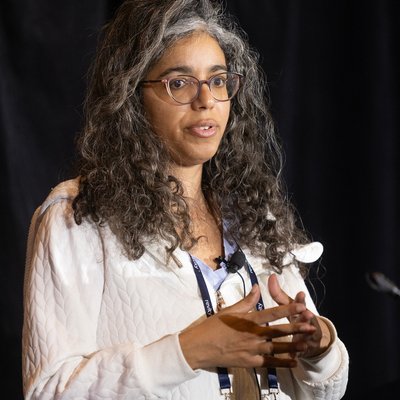
SPEAKER
Nada Amin
Associate Prof at Harvard & Co-founder at Midspiral
Nada Amin is an Associate Professor of Computer Science at Harvard SEAS. Previously, she was a University Lecturer in Programming Languages at the University of Cambridge; a member of the team behind the Scala programming language at the Ecole Polytechnique Federale de Lausanne (EPFL), where she pursued my PhD; and a software engineer at Google, on the compiler infrastructure supporting Gmail and other Google Apps. She holds bachelor of science and master of engineering degrees from the Massachusetts Institute of Technology (MIT). She recently co-founded Midspiral to bring verification to mainstream AI-assisted software development.
Upcoming sessions
See complete program3 November
2:35 PM · 30 min
Minimize Review and Increase Trust: A Verification-Aware Process for Agentic Programming
One of the most powerful uses of AI in software engineering is automation. But true automation with minimal human oversight requires a high degree of trust in the system’s ability to generate correct output. Given that long-running processes anchor the next output to its own prior outputs, an error along the way compounds quickly and may render the entire session or project unusable. We present a “verification-aware” process of programming with AI that embeds various verification methods — with formal verification as the grounding method. This process is flexible enough to accommodate tooling preferences, organization-specific policies, and cost/risk tolerance.
We’ll focus on practical patterns for verification-aware programming inspired by functional programming, how verifier feedback can guide agents to reason about correctness, and how to ensure informal and formal specifications don’t drift. The process and methods result in a considerable decrease in review burden while increasing confidence in output correctness.