ARTICLE
Reflection Before Augmentation
Explore AI's impact on individual vs. team productivity and the importance of reflection before tool adoption. Discover insights from AI DevCon and Muslim Tech

Hamza Oza
Last week was conference week for me. I spent the start of it at Tessl's AI DevCon and the end of it at Muslim Tech Fest, where I hosted a design roundtable.
AI DevCon was filled with discussions about agents, workflows, evaluation, and the future of software. Muslim Tech Fest was filled with discussions about AI too, but through a different lens: community, responsibility, and building meaningful careers. On the surface, they felt unrelated.
By the end of the week, I wasn't sure they were discussing different problems at all.
Why individual AI gains don't translate to teams
One of the recurring themes at AI DevCon was the challenge of scale. Many teams have now experienced what AI can do for an individual contributor. A developer paired with the right tools, whether Claude Code, Cursor, or Copilot, can move faster, explore more options, and ship a working prototype in an afternoon that would have taken a week not long ago.
The harder question is what happens next. How do those gains translate beyond the individual? How do teams share context when everyone has their own workflows, prompts, and agents? How do organisations maintain standards, govern behaviour, and build systems that multiple people can contribute to and trust? The conversations were less about whether AI works and more about how it fits into the reality of organisations.
This is where context engineering becomes the real work. Individual gains stay individual until a team can capture and share the context that produced them. Reusable, evaluated instructions for agents are one way teams turn one person's good workflow into a shared standard the whole organisation can rely on.
Reflection comes before the tool
A few days later, I found myself facilitating a design roundtable at Muslim Tech Fest. The discussion quickly moved away from tools and towards a more personal set of questions. People spoke about feeling overwhelmed by the pace of change, uncertainty around where to begin, and wanting to make better use of AI without always knowing how.
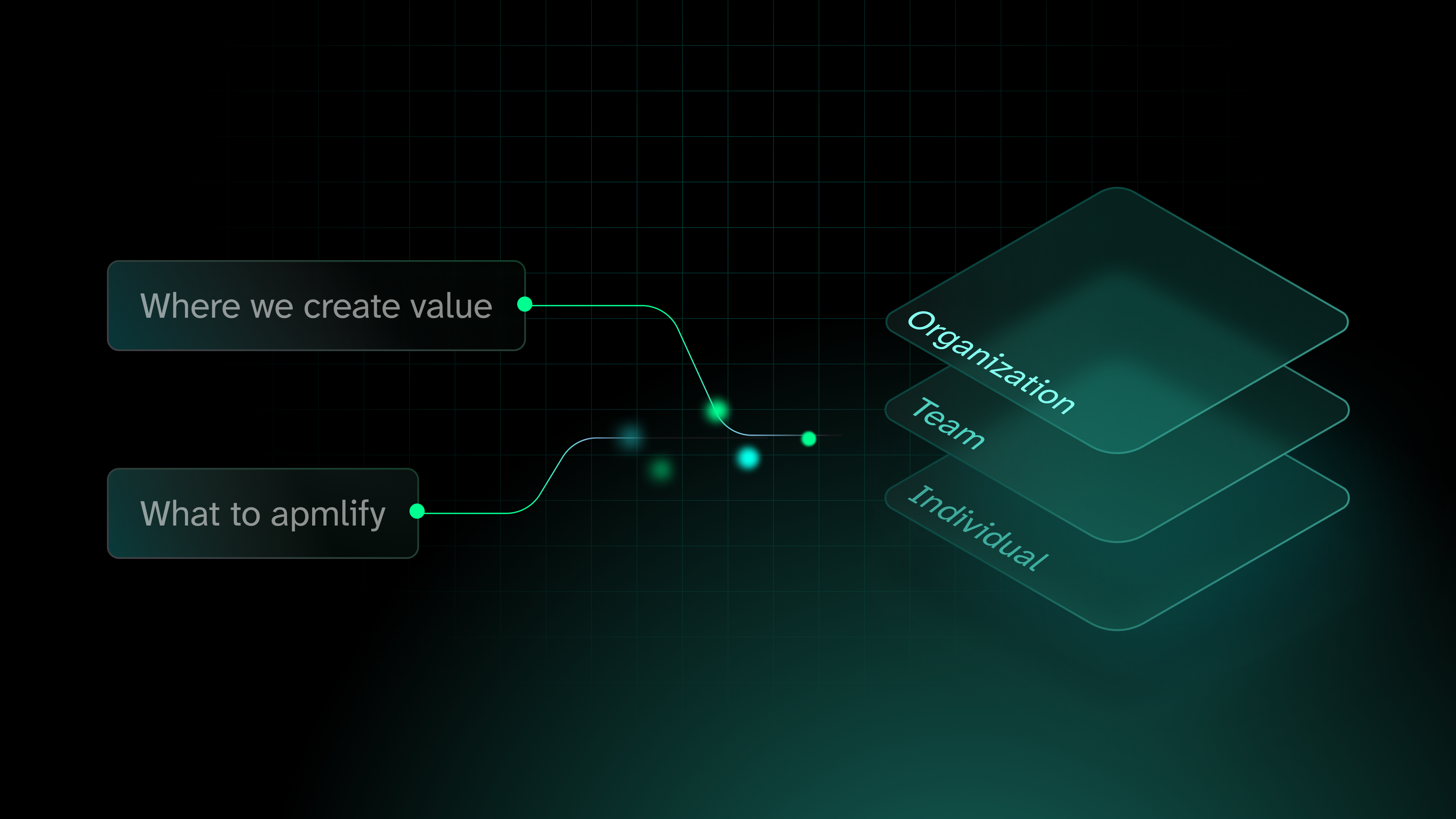
What struck me was that the most useful answers rarely started with the technology itself. Instead, they started with reflection. If someone understood where they created value, they could identify opportunities for amplification. If they were clear about their weaknesses, they could identify opportunities for AI to support them. If they knew which parts of their work depended on experience, judgement, or taste, they could make more informed decisions about what to delegate and what to retain. The challenge was not simply learning how to use AI.
It was understanding yourself well enough to use it intentionally.
What organisations should understand before adopting AI
The more I reflected on those conversations, the more relevant they felt to many of the challenges being discussed at AI DevCon. Before an individual can decide how AI should augment their work, they need to understand where they create value. Before an organisation can decide how AI should transform its operations, it needs to understand what makes it effective in the first place.
What are its strengths? Where does its advantage come from? What knowledge is unique to it, and what standards does it want to uphold?
Without those answers, adoption becomes reactive. Without those answers, the conversation starts with the tool rather than the problem.
The practical version of this for an engineering leader is unglamorous: before deciding which tools to buy or where to apply agents, audit where your team actually creates value and which standards you are unwilling to compromise. That audit, not the tooling decision, is the thing that makes everything after it work.
Reflection as a discipline, not an abstraction
One of the reasons this idea stayed with me is that it feels surprisingly familiar. Reflection occupies an important place within the Islamic tradition. Not reflection as an abstract exercise, but as a means of examining one's intentions, actions, strengths, shortcomings, and responsibilities. The goal is not simply greater self-awareness. The goal is growth. Reflection is valuable because it creates the conditions for more intentional action.
That framing gave me a different way of thinking about many of the conversations I heard throughout the week. Much of the discourse around AI focuses on capability: what the technology can do, which tasks it can automate, and how quickly it is improving. These are important questions, but they are not the only questions. An equally important question is what we choose to amplify.
If someone lacks clarity about where they contribute value, AI will not solve that problem. If a team lacks shared standards, more capable tools will not create them. If an organisation does not understand what makes it successful, adding AI to the equation is unlikely to provide the answer.
Technology can accelerate direction. It cannot provide direction.
What stays human
Perhaps this is why so many conversations about AI eventually become conversations about judgement. What should remain human? What deserves deeper care? What standards are worth preserving? What kind of work is worth striving for? These are not new questions. But they feel newly important in a world where capable tools are becoming increasingly abundant.
The most memorable conversations I heard last week were not really about AI. They were about understanding ourselves. As individuals, understanding where we create value. As teams, understanding how we work together. As organisations, understanding what makes us effective. Only then can we make informed decisions about what to automate, what to delegate, and what to amplify.
The tools will continue to improve. That much seems certain. The harder challenge may be understanding ourselves well enough to use them wisely.
COPY & SHARE
Hamza Oza
Hamza Oza is a Designer at Tessl building tools for complex technical domains and a Visiting Tutor at the Royal College of Art working at the intersection of design and technology.
READING
·
0%
IN THIS POST
COPY & SHARE
Hamza Oza
Hamza Oza is a Designer at Tessl building tools for complex technical domains and a Visiting Tutor at the Royal College of Art working at the intersection of design and technology.
YOUR NEXT READ
What your design system can't teach AI agents
Tessl's software factory ships work no designer has touched, which exposed what a design system cannot hand to an agent: composition, the judgment of what goes on a screen and what to leave out. By having agents diff generated screens against hand-redesigned ones, the team turned that tacit judgment into checkable rules and shipped them as skills that guide agents at creation and review. The result is one designer's taste, encoded once and reaching every screen the factory produces.
Hamza Oza